
Waterproof waders might not be your typical weekend wardrobe, but for a group of 20 WaterWatch volunteers gathered in the inner-north of the Merri Creek catchment in late November, these garments are simply the trademark of a passion for waterway health.
For once, these WaterWatch volunteers kept their socks dry, while attending MCMC’s first-ever Citizen Science networking workshop: although WaterWatch volunteers routinely head out to collect samples, record observations and monitor the health of local creeks, they rarely have the chance to meet one another.
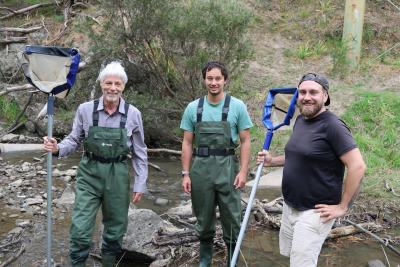
This workshop changed that, by creating a rare moment of connection for the people who help track the health of waterways across the Merri Creek, Darebin Creek and Plenty River catchments.
WaterWatch is a statewide river-health education and monitoring program that empowers schools, community groups and individuals to collect, interpret and discuss water-quality data. In the Merri Creek catchment, MCMC supports more than 50 volunteer WaterWatch monitors with training, equipment and opportunities to participate in data analysis. Together, these volunteers contribute to the long-term record of waterway health that underpins environmental advocacy and policy direction.
As MCMC’s Coordinator Citizen Science and Waterway Education, Julia Cirillo has seen how valuable such collaboration can be.
“We know that volunteers want to see that their contribution is making a difference,” says Julia. “And we wanted to give volunteers a platform to communicate their findings and discuss recommendations; to share their challenges and to add to their knowledge of subjects like climate change and weather impacts on water quality.”
WaterWatch volunteers test for indicators such as salinity, water clarity, nutrients, acidity and dissolved oxygen, using methods aligned with water-quality monitoring standards across Victoria and Australia. The data they collect is uploaded to a publicly available portal and collated into reports (available on our website), which provide a picture of waterway health over time.
Those reports help MCMC and partner organisations to raise community awareness, and with planning and advocacy efforts: highlighting trends, identifying problem areas and determining which stakeholders need to be involved in solutions. In highly urbanised areas like the lower Merri, where land use includes retail, residential and light industry, this long-term monitoring is particularly important in understanding the impacts of stormwater pollution, litter, detergents and oils entering the creek after rainfall.
The November workshop reflected this connection between local observations and broader scientific understanding, and speakers brought knowledge from a range of scientific fields. Meteorologist Joanna Hewes took volunteers on a deep dive into interpreting weather maps, how forecasts are made, and the challenges of predicting local conditions. Participants then tested their new knowledge by analysing weather scenarios.
Joanna enjoyed the two-way exchange of information and ideas. and acknowledged the passion of the participants in supporting the health and future of our waterways.
“We talked about how rivers, mountains and forests influence weather around Naarm/Melbourne, about expectations of a changing climate, and about the latest information on flash flooding.”
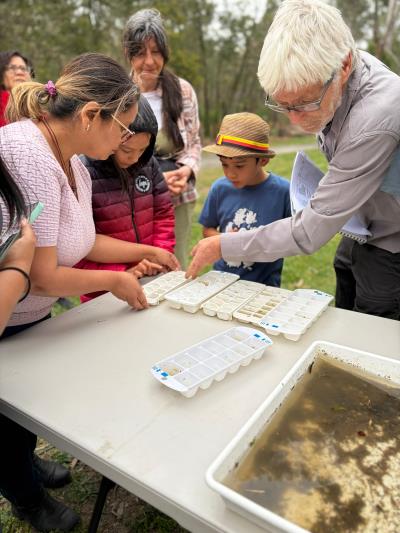
Next, Dr Lisa De Kleyn and Tyler King from La Trobe University’s Climate Change Adaptation Lab introduced an upcoming research project in which they will partner with WaterWatch and Estuary Watch. Through site visits, observation, photography, interviews and workshops, the research will explore how climate change is impacting waterways and the citizen science programs that monitor them, and how volunteer organisations can remain resilient, adaptive and sustainable in the face of increasing pressures.
Those pressures include climate change, ongoing urbanisation and pollution, all of which shape the conditions volunteers are observing on the ground.
The scientific expertise was complemented by the immediate, repeated and local observations characteristic of the WaterWatch and Citizen Science approach: Patrizio Effendy from the Darebin Creek Darlings presented a year’s worth of data from CT Barling Reserve in Reservoir, while Denise Ryan and Kirsten Macleod from the Friends of Merri Creek Stream Team shared insights into the waterbugs they’ve been documenting for more than 20 years in Fitzroy North.
Participants later told us they valued the community connection, the chance to hear directly from other monitoring groups, and the deeper understanding they gained of climate influences on waterway health.
“I’m more aware of the subtle indicators of waterway health and more motivated to contribute to their protection and monitoring,” said one volunteer.”
Click here if you’d like to know more about how you can help protect the long-term health of the Merri Creek – become a WaterWatch volunteer today.
Thank you to Melbourne Water for funding the workshop and supporting our WaterWatch volunteers. Watch this space for our 2026 WaterWatch workshop.
MCMC would like to thank Joanna Hewes, Dr Lisa De Kleyn, Tyler King, Patrizio Effendy, Denise Ryan and Kirsten Macleod.



 Merri Creek Management Committee. 2 Lee St, East Brunswick, Victoria, Australia 3057