
Caring for a creek that stretches over 60 kilometres requires more than just on-ground conservation work. Because Merri Creek weaves through shifting landscapes and diverse communities, protecting it also depends on the relationships between the people and organisations looking after the many different ‘patches’ connected to the creek system.
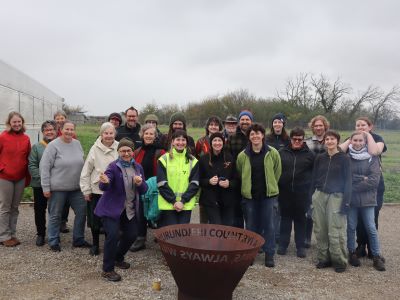 Attendees at Wollert Community Farm's one-year anniversary celebration. All photos by Maria Herrera, Whittlesea Community Connections.
That collaborative spirit was on display last month during National Reconciliation Week, when MCMC staff joined community members and project partners to celebrate the one-year anniversary of Wollert Community Farm, moving into its purpose-built premises, alongside nugal biik Plants and Seeds, the Indigenous plant nursery based within it. The farm is situated at the northern edge of Naarm/Melbourne and Curly Sedge Creek – a tributary of the Merri – meanders nearby.
The farm is a visionary collaboration between Whittlesea Community Connections and Yarra Valley Water, with support from Melbourne Polytechnic and the City of Whittlesea. It has evolved rapidly into a vibrant hub where community, conservation and cultivation meet.
For the farm’s Conservation Coordinator Charlotte Gordon, the past year has been a rewarding payoff after years of planning.
“We’ve now had a full year of seasonal programs on the site,” she says. “The nursery has had its first proper year of production. It’s been really exciting because we’ve been able to employ more people in the nursery, and suddenly it feels like a growing and connected workplace and community.”
Many of those new staff members were previously volunteers or university students who completed placements within Charlotte’s program, reflecting the project’s focus on building local skills, pathways and connections alongside environmental outcomes.
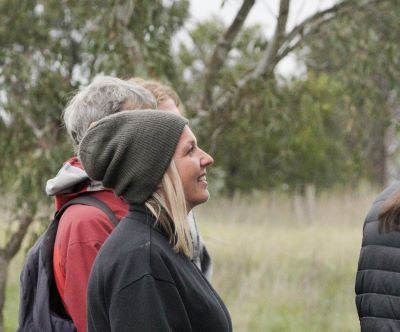 Attendees at the Walk on Country at Wollert Community Farm.
Today, those teams are expanding the farm’s cultural and educational reach, including through the nugal biik Rangers programs. Staff are also running regular introductory conservation sessions and designing spaces for both First Nations and non-Indigenous participants to connect. There’s also an exciting initiative to revive the farm’s agricultural roots by focusing on traditional First Nations food crops. This provides a vital avenue for community members living potentially disconnected from culture to access traditional foods.
While the modern site is celebrating its first full year of seasonal operations, MCMC's connection to this place runs much deeper. This is largely thanks to the open exchange of information between Charlotte and MCMC Ecological Restoration Program Manager Michael Longmore – a practice that reflects both MCMC’s organisational values and its daily work culture.
“I recently found an email Michael sent just two weeks after I started here in 2020,” reflects Charlotte. “The advice he gave has retained its importance to me even six years on. I’ve made a lot of decisions based on his points.”
That early exchange triggered a cascading network of support. It was Michael who initially connected the farm with the Narrap Rangers, the Country team of the Wurundjeri Woi-Wurrung Cultural Heritage Aboriginal Corporation, who have now been managing natural resource management works here for Yarra Valley Water for several years. Later, MCMC helped set up regular ecological monitoring infrastructure, ranging from reptile and frog surveys, to WaterWatch water-quality monitoring led by MCMC’s Julia Cirillo.
The fruits of this long-term capacity building are visible on the ground. Under the care of the nursery team, nugal biik Plants and Seeds grew over 100,000 plants in 2026: a massive leap from the 30,000 grown the year before. Operating as a social enterprise, the nursery has the infrastructure to scale up to 500,000 plants annually, generating sustainable income to support wider community programs.
This skyrocketing plant production directly feeds back into our shared catchment. A wonderful example of this circular on-ground collaboration is the supply of Curly Sedge (Carex tasmanica) seedlings from nugal biik Plants and Seeds to MCMC’s campaign project at Curly Sedge Creek. Harvested, nurtured, and grown locally, these distinctive, curly seedlings are heading back into the soil to restore their namesake tributary.
A welcome reward for these restoration efforts came last summer, when the team made a welcome discovery: a Growling Grass Frog, recorded during ongoing monitoring surveys. The threatened species had not been recorded this far north along the creek in more than twenty years – a hopeful sign that cared-for Country can offer inviting habitat for these frogs.
Last week’s anniversary open day, jointly organised by Charlotte and MCMC’s Dr Angela Foley, marked a major milestone in bringing the broader public into this space. Volunteers, community organisations and environmental groups came together to enjoy a morning tea and a guided walk where they were invited to observe the subtle signs of the waring (wombat) season as the weather transitions into the cold months.
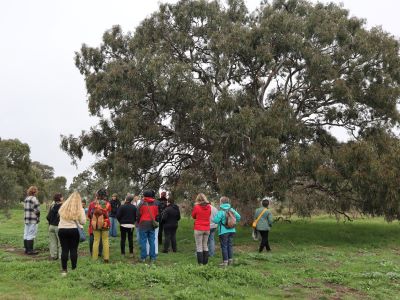 Attendees at Wollert Community Farm's one-year anniversary celebration.
“The point of the farm project has always been about better use of public land, and public land actually being used by the community,” says Charlotte. “This year has been the first time we’ve really had community coming in and shaping the space.”
That growing sense of community ownership is visible in both small and large ways: volunteers solving problems independently, local groups sharing resources, and increasing participation in conservation and cultural programs. It embodies the true spirit of catchment-wide conservation.
“In conservation, everyone is working on their little patches,” says Charlotte. “It’s just a great feeling when you stick your head up from your patch and realise that the patch you can see just over there is also being looked after. It feels like an ongoing relationship. Whenever we need support for this section of Curly Sedge Creek, it's so easy to get advice – and it’s great when that advice is from people who are doing the work on the exact same creek.”




 Merri Creek Management Committee. 2 Lee St, East Brunswick, Victoria, Australia 3057