
When Kate Looker’s father bought Merri Park in 1966, moving the family from potato farming in Kinglake to sheep farming on the banks of the Merri, the property gave Kate and her sister something they’d never had before: a creek to explore.
“We just loved it,” Kate remembers, of the 400 ha property near Wallan in the north of Merri Merri Country. “My sister and I would spend our entire weekends walking along the creek.”
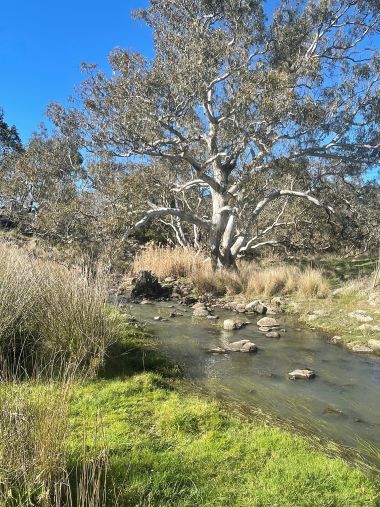 The Merri Creek at Merri Park, by Kate Looker.
They built cubbies and rafts, tried their luck at fishing, and headed out with matches to cook sausages – encountering the occasional snake along the way. But local land management in the 1960s reflected a very different era. Her father, along with neighbouring sheep farmers, managed the land intensively, leaving “not a blade of grass longer than an inch on the entire property.”
“That generation of farmers really had no idea about the environment,” Kate reflects. “They looked at the creek and thought about how many animals they could get down there.”
Almost 60 years later, the Merri remains at the heart of Kate’s connection to the land. But the creek corridor today looks very different from the one she explored as a child.
A new philosophy
As Kate and her peers grew up, a new philosophy took root. Armed with an agricultural science background and a keen eye for the degrading impact of invasive weeds, Kate began questioning inherited practices and envisioning a different path for the waterway.
“I remember coming across a booklet sometime in the 1970s that proposed a park extending along the Merri, from Dights Falls all the way to the source,” she says. “I thought, ‘Oh, what a great idea.’”
(MCMC celebrated huge progress towards that very idea in 2023 with the adoption of the marram baba Future Directions Plan, which will bring the vision of the Merri Creek Regional Parklands to life and is due for completion in 2050.)
Shortly after Kate took on the management of Merri Park, a local visitor arrived in her driveway and suggested forming a Landcare group. Kate jumped on board with enthusiasm. That led her to notice a neighbour planting trees along their shared waterway as part of Melbourne Water’s Stream Frontage Management Program. That moment sparked what would become around 25 years of hands-on restoration.
With five kilometres of stream frontage, the task was substantial. Kate and her family fenced off the creek corridor, removed an old weir, planted around 6,000 native trees and shrubs, and withdrew stock grazing entirely from the waterway. Off-stream watering systems were installed so livestock no longer needed direct access to the creek.
MCMC joins Kate’s journey
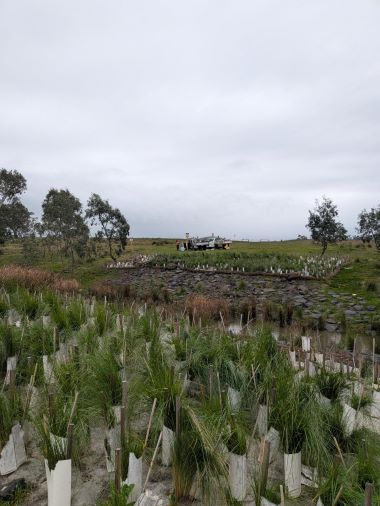 Planting by MCMC's Ecological Restoration Team at Kate's property, by Tony Bracey (MCMC).
Targeted weed control became another major focus. After an early contractor accidentally removed native raspberry, mistaking it for blackberries, a fellow Landcare member suggested Kate approach Merri Creek Management Committee (MCMC). Our crews have helped manage woody weeds and invasive species ever since.
Kate is quick to share the credit with nature itself – recalling a year when conditions were suddenly right and “all these little gum trees were growing up all by themselves”. But the transformation has been extraordinary. A 2021 report commissioned by Melbourne Water commended her family’s “excellent custodianship of the Merri over the past 30 or so years,” citing her section as “probably the best example of remnant riparian vegetation in the Merri Creek catchment.”
For Kate, the work proved a core principle: “If you look after the environment, you look after your property at the same time.”
The property has now been sold, although settlement is still a few years away, and as Kate prepares to hand over responsibility for a landscape she has nurtured over decades, her personal journey aligns with a crucial moment for the region.
wallan wallan Regional Parklands
Part of Merri Park falls within the proposed wallan wallan Regional Parkland, a 3,000-hectare parkland that would protect the upper reaches of the Merri Creek and provide natural open space for growing communities in Melbourne’s north.
The wallan wallan Regional Parkland Alliance is calling on the Victorian Government to establish the parkland while the opportunity remains to protect the Merri corridor alongside new housing, employment and industrial development planned for the region.
More than 3,000 people have signed a petition supporting the parkland. In July, Alliance members met with then Environment Minister Enver Erdogan to discuss its importance for biodiversity, the health of Merri Creek, Wurundjeri cultural heritage, flood mitigation and future communities. Later that month, they also met with a group of Merri Creek MPs to discuss the proposal.
For Kate, the proposed vision represents the fulfilment of that vision she first encountered as a student decades ago.
“It’d be lovely to think that you could actually do some sort of walk from start to finish,” she says, “and futuristically have something that’s really well preserved.”
Nearly 60 years after Kate and her sister spent their weekends building cubbies and following the creek to see where it would take them, establishing the wallan wallan Regional Parkland could give future generations the same opportunity: to walk along a healthy Merri, explore nature, and form a connection with the creek that lasts a lifetime.
Take action today
As a lead member of the wallan wallan Regional Parkland Alliance, MCMC is calling on the State Government to commit to the establishment of the wallan wallan Regional Parkland.
With key decisions underway, now is the time to get the Parkland over the line. Please take one minute to send an email to the Planning Minister using our simple template, to show your support for the wallan wallan Regional Parkland.
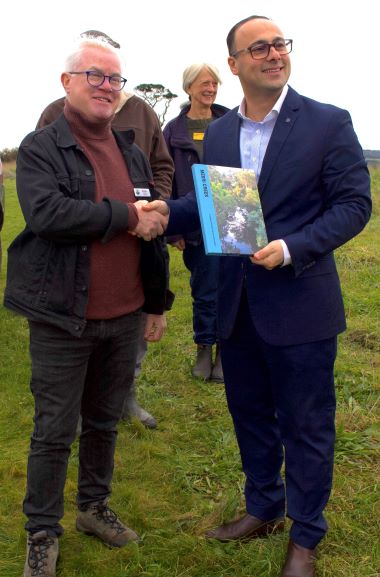 Former Minister for the Environment Enver Erdogan MP Green Hill with Dr Peter Ewer by Paul Macgregor.




 Merri Creek Management Committee. 2 Lee St, East Brunswick, Victoria, Australia 3057