
The Latham’s Snipe is a globetrotter that prefers to stay entirely out of the spotlight.
Quiet, cryptic and remarkably well camouflaged, these migratory shorebirds spend much of their time hidden among dense wetland grasses and reeds. For most of the year, they breed in northern Japan and eastern Siberia before making the extraordinary journey south along the East Asian-Australasian Flyway, arriving in Australia between August and April to rest and feed before returning north once again.
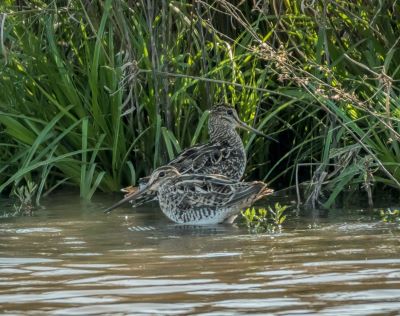 Latham's Snipe. Photos by Beverley Van Praagh.
Despite travelling thousands of kilometres each year, Latham’s Snipe often go unnoticed. But for MCMC Ecological Restoration Team Leader Nicola Babbage, one encounter in the Merri Creek catchment has stayed with her.
“It was early December and we were working in a grassland at the Aitken Creek confluence in Craigieburn,” Nicola recalls. “We stopped to inspect the tall grasses on the edge of the creek, planning the day’s work, when all of a sudden, we heard one loud, distinct ‘krek!’ and the snipe flew straight out of the grasses past us.”
“Its long, slender bill and striped, mottled plumage were an immediate giveaway. We just looked at each other and said, ‘That was the snipe!’”
For Nicola, the moment carried a sense of awe: not only because the species is rarely seen, but because of the journey the bird had taken to get there.
“We knew they had been seen at the site before, and that they often return to the same places each year,” she says. “But actually seeing one was something really special. You think about the huge migration these birds make every year, and how much they rely on safe wetland habitat along the way.”
Latham’s Snipe depend on freshwater wetlands with low, dense vegetation where they can shelter during the day. At night, they come out to feed – foraging in soft, shallow mudflats for seeds, insects, and small invertebrates. These habitats once occurred extensively across south-eastern Australia, including throughout the Merri Creek catchment.
But today, they are increasingly rare. Across the Plenty and Merri Plains, more than 90 per cent of freshwater marshland habitat has been lost or heavily degraded since colonisation, largely through drainage for agriculture and urban development.
One of the most significant examples is Herne Swamp, a vast wetland system on Melbourne’s northern fringe that once covered more than 600 hectares. Although much of the swamp was drained in the early twentieth century, fragments of its original ecology still persist – particularly along the Melbourne–Sydney rail corridor.
These remnants continue to support threatened plants, frogs and grassland species, and provide habitat for wetland birds. According to MCMC’s Michael Longmore Latham’s Snipe have been sighted recently at Herne Swamp – very close to the area targeted by MCMC for upcoming restoration work – as well as in the grasslands further south around Craigieburn.
The species is now listed as Vulnerable under both federal and Victorian environmental legislation, with scientists estimating population declines of around 30 per cent over the last three generations. Habitat loss, altered waterways, drought and large-scale fires are all contributing pressures.
For migratory birds like the snipe, every remaining wetland matters.
“We really want to protect these pockets of suitable habitat,” Nicola says. “Especially for migratory species that rely on having those stopover points along their migration routes where they can safely rest, feed and recover.”
That understanding sits at the heart of our restoration work and care for Wurundjeri Country in the upper Merri catchment. The team targets invasive weeds like blackberries that threaten to choke the dense reeds the Snipe relies on for daytime cover. However, the team takes a highly strategic approach: during weeding and ecological burns, they carefully manage the landscape to retain patches of protective vegetation – even if it includes non-local species – ensuring the birds are never left exposed.
By carefully conducting weed control to allow key indigenous wetland plants to regenerate, utilising ecological burning, and returning health to this area, the team is actively creating the shallow, muddy margins and protective cover that Latham’s Snipe depend on.
Small, hidden, and easy to miss, this incredible shorebird is a reminder that even heavily altered landscapes can hold remarkable ecological values, and that restoring wetlands today can help ensure these migratory visitors continue returning to the Merri catchment each year.
If you would like to be a part of this vision, please consider supporting our current fundraising campaign to fund vital, on-ground restoration work in the upper Merri catchment.




 Merri Creek Management Committee. 2 Lee St, East Brunswick, Victoria, Australia 3057