
If you’re lucky enough to get a window seat on a Melbourne-bound train from Wallan Station, you’ll look out over a landscape shaped by decades of agricultural drainage and modern development.
“Wallan is growing so rapidly,” says Claudia James, from Wallan Environment Group. “Every month or two I notice a high-density housing development that has gone up.”
It’s hard to imagine that this was once the heart of Herne Swamp – a vast, 600-hectare wetland that teemed with thousands of brolgas, magpie geese and black swans. Today, less than ten percent of the region’s original freshwater marshland remains.
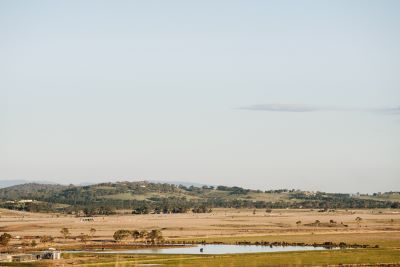 Herne Swamp, viewed here from Green Hill, was once a vast, 600-hectare wetland. Photo by Max Roux.
But right along that railway line to Melbourne, a remarkable survival story has been quietly unfolding.
The long, narrow corridor of rail reserve between Beveridge and Wallan has become a sanctuary for some of the catchment’s rarest ecological communities.
Stepping into the reserve reveals a surprisingly varied landscape on a miniature scale. It’s a place of shifting gradients, where rocky rises and small escarpments topped with native plains grasslands slope gently down into wet, swampy depressions. Here, water still accumulates after heavy rains, maintaining the precious, federally protected Seasonal Herbaceous Wetland communities that have vanished elsewhere.
This rich diversity is no accident; it is the product of a very specific land management history.
Before colonisation, Wurundjeri people responded to these plains using cultural burning. Post-contact farmers continued using fire to clear stubble. Then, when the railway line was built right through the middle of the swamp, a new kind of fire regime took over. To minimise the risk of stray sparks and embers from steam trains igniting dry vegetation and risking a spread to surrounding farmland, railway workers conducted regular fuel-reduction burns along the railway corridor to keep trackside growth low.
Flora of the Wallan rail reserve
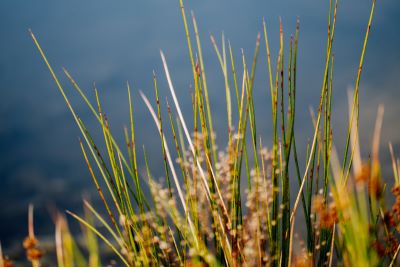
The flora persisting inside the Wallan rail corridor at the centre of our campaign, reads like a roll call of endangered Australian plants. Among them is murnong (Plains Yam Daisy), a plant that thrives in the wet, swampy depressions. Murnong was a traditional food staple for First Peoples across southeastern Australia and it continues to hold cultural significance today.
“There is also one called a Swamp Daisy (Allittia cardiocarpa),” Robbie says. “I didn’t know it was even in the Merri Creek catchment until recently. It’s really rare in the region, has a beautiful daisy flower and it needs this seasonal inundation. Another is the Swamp Everlasting (Xerochrysum palustre), which is critically endangered in Victoria. It’s a really beautiful flower that relies on the seasonal flooding that still happens in parts of the rail corridor."
Perhaps the reserve's most intriguing ecological mystery is its population of Diuris, commonly known as Golden Moth orchids.
“The Golden Moth orchid flowers are a bit smaller than other orchids present on the site,” says Robbie. “They flower at a different time to the Common Golden Moth orchids.”
This mystery plant has not yet been formally studied and may represent a completely unique, undescribed species, or a vital outlying population of the nationally endangered Small Golden Moth orchid (Diuris basaltica) or Clumping Golden Moth orchid (Diuris gregaria).
With several orchid species still hanging on – and a history of others lost to past rail works – the stakes are high. “Working on the site will allow us to ensure remaining orchid populations are protected from weed invasion and given the best chance to flourish,” Robbie explains.
This constant, predictable cycle of fire ceased in the 1980s. In the decades since, the absence of regular burning has allowed biomass to build up. Thick layers of dead grass and invasive weeds like gorse have begun to choke out the delicate spaces between native tussocks where small herbs and wildflowers rely on sunlight to germinate.
This is why reintroducing careful ecological burning is now a key priority for Merri Creek Management Committee, as part of our campaign to Sow the seeds of a wetland.
“The area we want to work in, if we can raise the funds, is one of the few parts of the landscape that still includes remnant vegetation,” says Robbie Belchamber, Merri Creek Management Committee’s Ecological Restoration Team Leader.
“The historic fire regime played a big part in that. In some areas of the reserve, fencing along the corridor also helped protect remnant patches from grazing and other pressures. Some sections also continue to receive seasonal flooding, creating refuge habitat for species that have disappeared elsewhere.”
“There’s a lot to learn from working in this kind of area,” Robbie says. “It’s a really important resource, particularly for seeds that could help restore the wider landscape.”
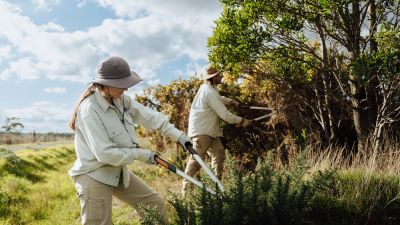 MCMC Ecological Restoration Team Leaders, Robbie Belchamber and Nicola Babbage, by Max Roux.
Restoring the landscape means returning a controlled, sensitive fire regime to the area. Working in negotiation with rail operators, MCMC’s Ecological Restoration team hopes to carry out a major ecological burn within the reserve.
The fire will clear out the suffocating thatch, open up the inter-tussock spaces, and allow native herbs to re-establish. Following the burn, intensive weed control will target the aggressive gorse and grasses that compete for space.
Crucially, this work will unlock the reserve's potential to act as a seed orchard. By safely harvesting seeds from these healthy remnant populations, MCMC can propagate threatened species off-site without over-exploiting the wild plants.
These seeds will become the lifeblood for the future, large-scale restoration of the broader Herne Swamp and the proposed wallan wallan Regional Parkland.
“Our vision for wallan wallan Regional Parkland is about protecting the landscape, but it’s also to put people back in contact with nature,” explains Claudia.
“We have a potential regional park right on our doorsteps that will follow the creek lines and incorporate swampy wetland areas right across to where the volcanic cones are. Even if we secure approval, that will take time, but it’s important to work together and do what you can when you can.”




 Merri Creek Management Committee. 2 Lee St, East Brunswick, Victoria, Australia 3057