
 Merri Creek Management Committee (MCMC) is deeply concerned about the state government’s proposal to rezone the site of the former Lakeside Secondary College at 31 Radford Rd Reservoir, from Public Use Zone to Industrial Zone, in preparation for its sale on the open market.
The rear portion of this property, between the school oval and Merri Creek, has functioned as public open space since the mid-1980s. It has been managed for many years by the City of Darebin as open space for passive recreation, ands biodiversity and waterway significance.
Its values include:
1. The Merri Creek Shared Path/Trail: This trail traverses the site and is part of the Metropolitan Trail Network and connects the Yarra Main Trail north along Merri Creek to the Ring Rd.
2. Significant Linear Open Space Connectivity: The Darebin Open Space Strategy nominates this area as recreational open space.
3. Significant Biodiversity Values: These include nationally-listed EPBC species and communities. These values are mapped and described in detail in Darebin Council’s draft Natural Heritage Plan 2011.
4. Significant Waterway Values: Merri Creek is a Melbourne’s most popular urban creek and is greatly valued by the community.
The Education Department has offered to sell the land to Darebin Council, but at a commercial price that Council does not want to pay. MCMC supports the land remaining as public open space for its important recreational, biodiversity and waterway values, at no cost to the community.
 MCMC has received $87,932 from the Helen Macpherson Smith Trust to restore a gap in the habitat corridor along the Merri Creek in Fawkner. The three-year Habitat Heroes project starts in June 2014. It will bring Wurundjeri Traditional Land Owners and the diverse local community together with Merri Creek Management Committee through hands-on activities and events.
The Habitat Heroes project will provide opportunities for greater understanding of, and involvement in local biodiversity. It will also engage Wurundjeri Traditional Owners in land management practices. The Habitat Heroes are both the community members working on restoring habitat, and the Top Ten plant habitat species that are the focus of the project.
The first community planting is on 24 August 2014: participants will be Welcomed to Country by Traditional Owners, see a local snakes and lizards display and help to revegetate gaps in the habitat with trees and shrubs. This will be supplemented with weed control and ecological/cultural burning of native grasslands, enabling the Wurundjeri Narrap land management team and MCMC to work in partnership.
Residents can discover local biodiversity through interpretative events, bird surveys, and finding out how to use the 'Top Ten' Habitat Hero plant species in their gardens.
Merri Creek Management Committee (MCMC) is no longer publishing the quarterly newsletter, Merri News, But don’t worry, you can now receive the Merri-e News by email. Just email MCMC at: and ask to be added to the Merri-e News list. You can still download previous issues of Merri News.
Research by Chris Walsh and colleagues at the Waterway Ecosystem Research Group, University of Melbourne, paints a dir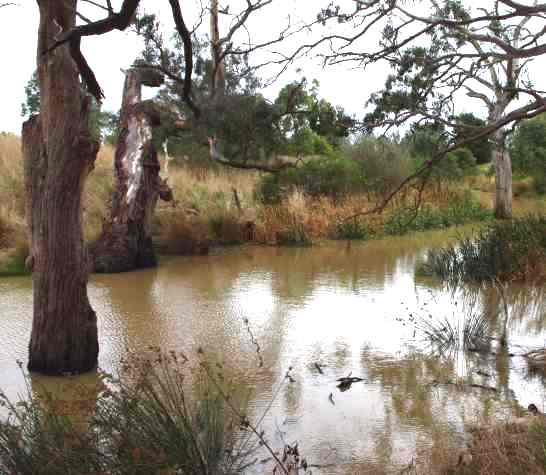 e picture of the in-stream ecological future of Merri Creek. As the middle and upper catchment urbanises:
• Use of current ‘best practice’ urban stormwater management practices will result in loss of existing ecological values in upper Merri Creek.
• The risk of loss of values under Melbourne Water's preliminary Integrated Water Cycle Management Plan is very high
• Much better and stronger strategies for management of urban stormwater are needed to reduce the risk of loss of values.
• Harvesting and use of stormwater is the most straightforward way to do better than we do currently.
• If stormwater isn’t harvested, very large areas of open space will be needed, ideally along drainage lines, to allow adequate losses of stormwater though infiltration and evapotranspiration.
• If we fail to stem a decline in upstream values, the likelihood of restoring the degraded condition of Merri Creek downstream decreases even further.
MCMC is greatly disappointed by the final Biodiversity Conservation Strategy (BCS) for Melbourne’s massive growth corridors, especially as it affects the Merri catchment. Growling Grass Frog corridors along many parts of the creek are significantly narrower than ecologists recommend and ancient River Red Gums have been left unprotected. The Federal Minister approved the inadequate BCS, submitted by the Victorian Government, days before the federal election.
Check out the Platypus Spot website to record and map Platypus sightings. The website is a joint project between Melbourne Water and CESAR, the ecological and biological research organisation that conducts the biannual platypus survey program.
Ever wanted to fly like a bird?
You can now take a ‘Virtual tour’ using Google Earth which allows you to explore Galada Tamboore as if you were soaring above it like a Brown Falcon. In a few minutes you can virtually whiz up the gorge and soar above the grasslands seeing features that would take hours to see on foot. The virtual tour includes links to the results of Friends of Merri Creek’s birdwatching and includes other important information for you to plan a real-world visit .

Page 16 of 16
Merri Events Calendar
09:30AM - 11:30AM
FoMC Coburg Lake & Surrounds - Wednesday Working Bee
09:50AM - 12:00PM
FoMC Wednesday Volunteers
09:30AM - 11:30AM
FoMC Coburg Lake & Surrounds - Friday Working Bee
09:30AM - 11:30AM
FoMC Coburg Lake & Surrounds - Wednesday Working Bee
09:30AM - 11:30AM
FoMC Coburg Lake & Surrounds - Friday Working Bee
10:00AM - 12:00PM
FoMC Litter Cleanup - Brunswick East
02:00PM - 03:30PM
FoMC: StreamTeam Water Quality Testing
09:30AM - 11:30AM
FoMC Coburg Lake & Surrounds - Wednesday Working Bee
09:30AM - 11:30AM
FoMC Coburg Lake & Surrounds - Friday Working Bee
10:00AM - 12:00PM
FoMC @ Merri Park - Woody Weed Whacking



Connect on Social Media |


 Merri Creek Management Committee. 2 Lee St, East Brunswick, Victoria, Australia 3057 (view map in new window )
Phone:(03) 9380 8199 Email: ABN: 13 025 599 242
© Merri Creek Management Committee