
 Metro Trains, a customer of MCMC, was recognised with a High Commendation award in the Excellence in Environmental Outcomes Category at the annual Infrastructure Sustainability Council awards on 7 September, 2023. The Biodiversity Manager of Metro Trains, Ben Roberts, said "I feel the award is a great recognition of the skilled and dedicated effort that MCMC have contributed since the inception of the biosite program. Throughout the program, MCMC have provided a consistent and reliable service which has resulted in the MCMC managed sites steadily recovering over this time, including improving site conditions which have significantly increased threatened species abundance."
Achievements made by Metro Trains at the Biosites include: 314% increase in abundance of threatened species; recovery of three Threatened Ecological Commuities; the return of five previously unrecorded threatened species; and the introduction of regular cool season eco-burns as a "business-as-usual" practice.
Also see the video of our work with Metro Trains on remnant rail reserves in this segment on Gardening Australia in 2021.
 This beautiful full colour book, Merri Creek: a ribbon of nature in Melbourne’s North, celebrates 50 years of community efforts to protect and restore one of Melbourne’s most popular waterways. Contributions from more than 20 photographers demonstrate the vibrant flora, fauna, and history of the creek.
Based on a series of banners developed for Merri Creek Management Committee in 2015, the book highlights the outstanding community achievement since 1975 in transforming the Merri Creek from a weed-smothered drain to a much-loved waterway running through a bushland corridor.
$65 from the Friends of Merri Creek on-line shop
“For thousands of years, the Creek and surrounding lands were a source of food and culture which sustained the traditional custodians, the Wurundjeri Woi-wurrung people. But by 1970 the Merri was in crisis. Heavily polluted, with much of the native vegetation and wildlife gone, it had become a drain and a dumping ground. Over the past few decades, the story of the Merri has been one of transformation. […] Today, the Merri Creek is flourishing again, but there are many challenges ahead and there is still much work to be done. We invite you to join in this community effort.”
 Luisa Macmillan, MCMC's Manager for over 20 years, was awarded the 2023 Environmental Sustainability Award at Merri-bek City Council Community Awards on 31 October. Luisa was honoured for her leadership in overseing the ecological restoration of Merri Creek parkland in Merri-bek and beyond, making it one of the area's most popular and valued environmental assets and an inspiration for other degraded urban waterways in Melbourne.
Luisa played a key role in developing and maintaining relationships with Merri-bek and the five other Councils on the MCMC, as well as with state government agencies, research and education institutions, and community organisations – particularly Friends of Merri Creek. She has been an effective advocate for the health of the Merri and tributaries through membership of advisory committees, strategic planning processes, advice on planning permit applications, and appearance at VCAT and Planning Panels. Importantly, she raised awareness of the risks of development on sodic and dispersive soils in the upper Merri catchment, which result in sediment-laden creek flows downstream when disturbed.
Luisa gave thanks to Ann McGregor who nominated her and accepted the award on behalf of: Merri Creek itself; the hundreds of volunteers who have supported Merri Creek over many decades; her work colleagues past and present at MCMC; and Council officers and councillors; all who have been a vital part of Merri Creek’s revitalisation.
Photo: Luisa Macmillan with the 2023 Mayor of Merri-bek, Cr Angelica Panopolous
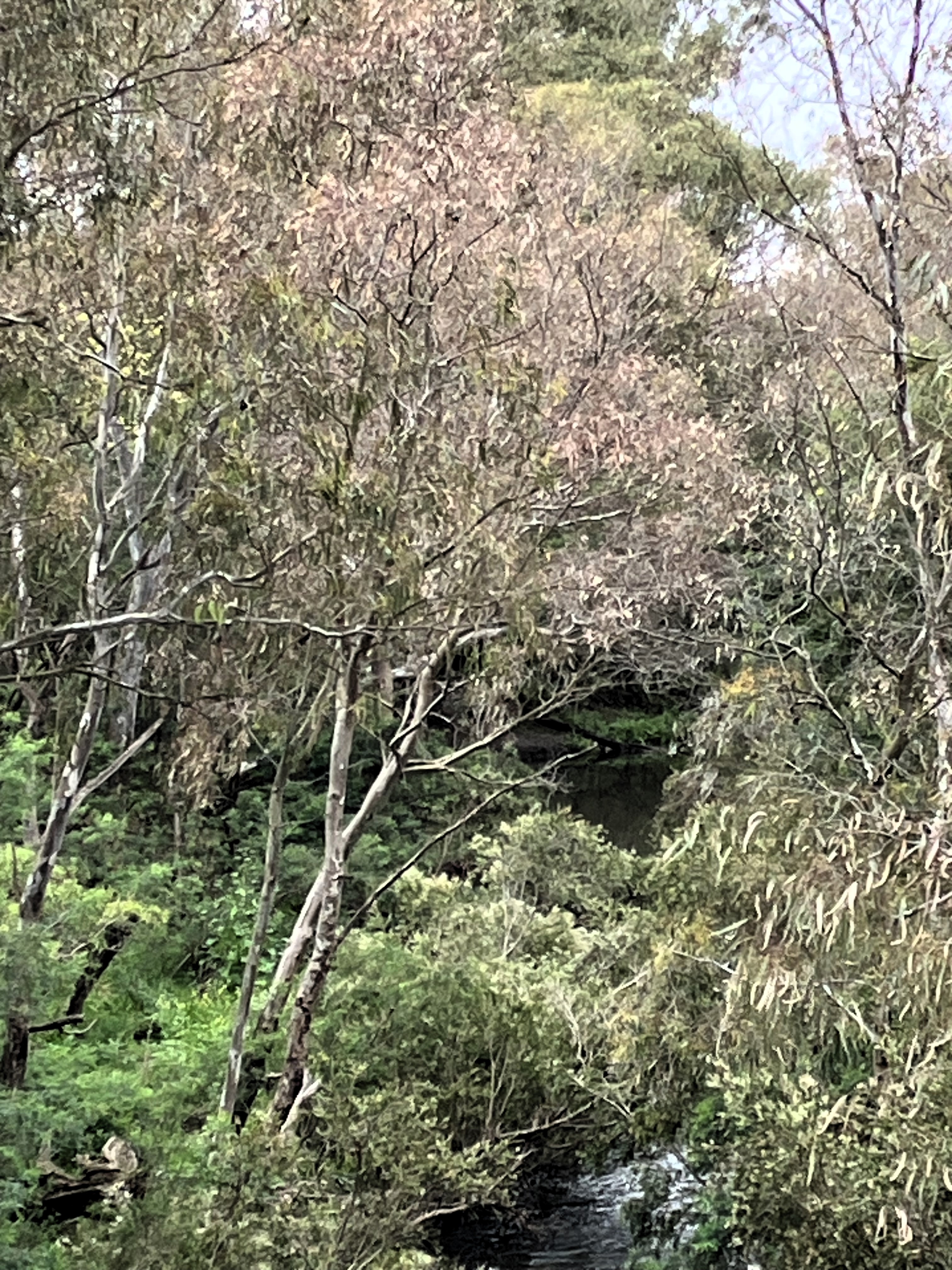 The apparent decline of eucalypts along Merri Creek is caused by a boom in psyllids - an insect that feeds on sap and secretes a sugary 'lerp'. These insects occur naturally and cause these sort of effects from time to time - one of the natural cycles that thin out the mass thickets of young eucalypt saplings and allow a smaller number of gum trees to mature and dominate. This issue extends throughout greater Melbourne to north of the Great Divide, but along the Merri, it tends to mostly affect River Red Gums, leaving other gums, like yellow gums and manna gums, much less affected.
However, the scale on which it is now occurring is highly unusual. Around Melbourne, this boom may be partly caused by more favourable conditions, such as flowering plants in our gardens providing a reliable source of nectar for larger, more aggressive, nectar-eating birds, such as Noisy Miners and Rainbow Lorikeets. These large birds are displacing some of the smaller insect-eating birds such as Pardalotes, which would feed on the psyllids. Other factors, such as warmer weather, unseasonal rain, other effects of climate change, and changes in hydrology from urban development, may also cause further stress on the gums.
 MCMC's Executive Officer, Bernadette Thomas, recently participated in two water network events:
Melbourne Biodiversity Network: This series of workshops was launched by the University of Melbourne and design studio, OFFICE to create a network of public spaces forming a bio-diverse web of ecological corridors throughout Melbourne. MCMC shared information about our history, strong community involvement, engagement with the diverse Merri community, partnering with the Wurundjeri Woi-wurrung, and our ideas for how collaboration works well. The Network's aim is to link these underutilised spaces with existing corridors, like Merri Creek, and so improve biodiversity within our city.
 Working with Water: This event series, hosted by Regeneration Projects and La Loyka, involved five workshops focused on how different waterway organisations worked to address climate change, biodiversity, and habitat loss. MCMC joined Kooyongkoot Alliance, and again highlighted the long history of community involvement, participation, and leadership in bringing Merri Creek back to life. The focus was on the importance of connection to nature, learning from people using the creek and those working to restore it, and the interconnections between urban biodiversity, ecosystem restoration, and community wellbeing – all core to MCMC’s vision. Download a summary of this event.
 Our Administration Officer, Monica Wiilliamson, retired from MCMC in October 2023 after 15 years of being the go-to person in the office for all things admin, organising, community, committee, and much more - including 10 years of taking the Minutes at our Committee meetings and seeing us safely through the COVID lockdowns.
Among Monica's many achievements was organising MCMC's 20th Anniversary Celebration, a photographic exhibition of beautiful black and white photos of Galada Tamboore by local photographer David Tatnall. Highlights included working with and learning from Aboriginal Elders, Uncle Dave Wandin and Uncle Jack Charles, and hearing their stories of growing up along the Merri. She also fielded many calls from the public, including one report of seeing a crocodile in the creek!
Many thanks to Monica for her commitment and contribution to MCMC over many years. We'll miss her but we'll still stay in touch, as she voluntarily looks after the Friends of Merri Creek on-line shop - where you can also buy a number of Merri Creek gifts.
 Wurundjeri Woi-wurrung people understand the September and October months as Porneet season on Country. This time has many warmer and sunnier days which plants and animals respond to. In Porneet this year, MCMC's community activities have focussed on birds and we've seen them fluttering around to mate and foraging for nest building materials, and noted that nests range from leafy, twiggy constructions, to mud lined with feathers, or woven with horsehair!
Merri Creek Primary School students enjoyed spying on three nests by the Merri and saw the arrival of Pacific Black Ducks, Australian Wood Ducks, Chestnut Teals and one Northern Mallard. The children could easily identify these birds by using the Friends of Merri Creek’s brochure: Merri Birds.
During vacation program in Hawkstowe Recreation Reserve in Plenty Gorge Parklands, we observed Australian Wood Ducks searching for food with 11 fluffy chicks, and drew Sacred Kingfishers and learnt about their long journey and special habits.
In Merri-bek, children queued up to have local birds painted on their hands as part of a festival in Coburg. This led to wonderful exchanges about indigenous biodiversity, and to noticing the pinkishness of Kookaburra's beaks and the bluishness of wing feathers, the importance of healthy feet and places to perch, the different shapes of beaks, the long flights for migrating Sacred Kingfishers to visit Merri Creek.
Email if you’d like support to focus on Wurundjeri Woi-wurrung seasons and local plants and animals.
 We’re continuing to strengthen our outreach with early years communities in Whittlesea and Hume. We work with educators to explore opportunities that are local, respect indigenous biodiversity and leave no footprint. When we support educators to visit nearby natural areas with young children, we suggest how to think about Bush Kinder and Nature Play differently.
Early years learning programs that take children for walks and exploration have been shown to have strong positive health impacts.
MCMC’s A Little Nature Play program introduces early years educators to walkable beautiful places which you can enjoy with children and leave no footprint.
Our A Little Nature Play program provides opportunities which value children’s social and physical wellbeing. After we get together and explore ideas and places with staff, our goal is to take children out together and encourage long-term independent connections to nearby places.
 To commemorate National Threatened Species Day, the Merri Paddle, a subgroup of Friends of Merri Creek, recently hosted a Roundtable of Stakeholders to discuss ways to bring platypus back to the Merri. Participants from member councils (Cities of Hume, Whittlesea, Merri-bek and Yarra) and organisations, including Melbourne Water, the EPA, DEECA & AQUEST (RMIT), presented and participated in discussions on practical solutions for improving Merri Creek at specific sites to facilitate an increase in platypus numbers on the Merri. Besides Merri Paddle and Friends of Merri Creek, the community was represented by Rotary, Bacchus Marsh Platypus Alliance and MCMC. The event was a positive, collaborative and pragmatic approach that we hope will solidify and create new partnerships in order to reduce pollution levels in the Merri.
To learn more about the Merri Paddle group go to: https://www.friendsofmerricreek.org.au/merri-paddle
Sincere thanks to the funders of the event: Melbourne Water, Friends of Merri Creek, MCMC and the City of Merri-bek with support from DEECA and the City of Darebin.
 In July 2023, MCMC received a fresh batch of 180 Silver Banksia seedlings (Banksia marginata, tree form) from the Friends of the Forgotten Woodlands, a volunteer group who have been working hard to rebuild the Banksia, Bursaria and Sheoak woodlands that were once a keystone in the ecology of the Victorian Volcanic Plains. Together with 50 seedlings grown by VINC, these plants will be added into our Tree Banksia Orchard which was established in Fawkner last year with help from many volunteers and support from the Merri Creek Environment Fund. The Orchard currently brings together genetic material from 10 different Silver Banksia populations across the volcanic plains, alongside material from three populations growing in locations whose current climate matches Melbourne’s future modelled climate. We will add provenances from Clarkfield and Eynesbury to the mix, bringing the number of volcanic plains populations represented in the Orchard to 12. A successful planting with LGBTIQ Friends of Bababi Djinanang was held on Saturday 12th August.
More Articles …
- MCMC's new Executive Officer
- Connecting teachers to Wurundjeri Woi-wurrung Country
- Drawing in NAIDOC Week
- Our early years work in local natural areas grows
- Have you seen the new marram baba signs?
- Whittlesea College students get into WaterWatch
- New WaterWatch group in Coburg
- Cultural Connections at the Merri-Birrarung Confluence
- Donation from Merri Creek itself!
- MCMC President awarded OAM
Page 9 of 16
Merri Events Calendar
09:30AM - 11:30AM
FoMC Coburg Lake & Surrounds - Wednesday Working Bee
09:50AM - 12:00PM
FoMC Wednesday Volunteers
09:30AM - 11:30AM
FoMC Coburg Lake & Surrounds - Friday Working Bee
09:30AM - 11:30AM
FoMC Coburg Lake & Surrounds - Wednesday Working Bee
09:30AM - 11:30AM
FoMC Coburg Lake & Surrounds - Friday Working Bee
10:00AM - 12:00PM
FoMC Litter Cleanup - Brunswick East
02:00PM - 03:30PM
FoMC: StreamTeam Water Quality Testing
09:30AM - 11:30AM
FoMC Coburg Lake & Surrounds - Wednesday Working Bee
09:30AM - 11:30AM
FoMC Coburg Lake & Surrounds - Friday Working Bee
10:00AM - 12:00PM
FoMC @ Merri Park - Woody Weed Whacking



Connect on Social Media |


 Merri Creek Management Committee. 2 Lee St, East Brunswick, Victoria, Australia 3057 (view map in new window )
Phone:(03) 9380 8199 Email: ABN: 13 025 599 242
© Merri Creek Management Committee