
When Lauren Branch walks along the Merri Creek in the hot, dry seasons of Gunyang (kangaroo apple season) and Biderang (hot and dry), there are usually around 20 pairs of little feet following close behind. As a teacher at Coburg’s Barry Beckett Children’s Centre (which enjoys a location just five minutes’ walk from the Merri) Lauren sees the creek as the perfect setting for place-based learning.
“Interacting with the creek gives opportunities for STEM (Science, Technology, English and Mathematics) as well as environment and wellbeing,” she says.
One of the concepts that Lauren enjoys exploring with her four- and five-year old kinder students is the changing of seasons according to what they are noticing in front of them, guided by the Wurundjeri seasonal calendar.
“At the beginning of the season, everything's quite green at the creek,” says Lauren. “You see more flowers out this time of year, but it will start to dry out very soon – even on the ground. The eucalyptus trees present in these really beautiful colours, all the way from yellows and reds, to pinks and greens, muted yellows and browns, even into purply colours.”
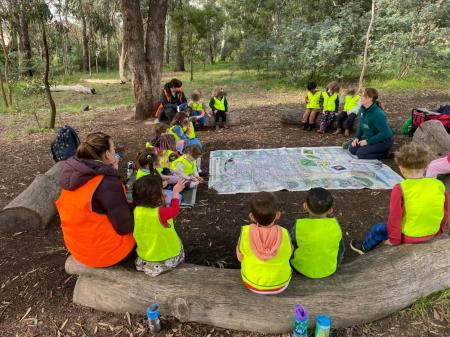 Students from Barry Beckett Children's Centre, with MCMC's Julia Cirillo.
Here at Merri Creek Management Committee, we celebrated the incredible commitment of volunteers the world over, on International Volunteers Day in December as well as year-round. Thank you!
Volunteers like you achieve so much for the Merri Creek: cleaning up litter, serving on committees to ensure the work of volunteer groups is effective, sharing a connection to nature with others, testing water-quality, planting trees, weeding and monitoring birds and other species. Happy International Volunteers’ Day to all our wonderful volunteers!
Hear from our WaterWatch and Litter Clean-up Coordinator, Julia Cirillo, together with some of the wonderful volunteers from the Merri Platypus Paddle Group about why volunteering makes so much of an impact – for us and for those who do it – in this video.
MCMC's Julia Cirillo with Colin Abbott, Heather Harris and Helena Kelada from the Merri Platypus Paddle Group talk about the joys of volunteering.
Find out more about volunteering with the Friends of Merri Creek or the Merri Creek Management Committee.
Video kindly shared by the Department of Energy, Environment, and Climate Action.
Do you live near the Merri Creek close to the Fawkner area? Are you from a Culturally and Linguistically Diverse or Indigenous Australian background? Do you want to help populations of Growling Grass Frog living near you?
Merri Creek Management Committee is seeking volunteers for a new WaterWatch group, to collect important information about what these precious frogs need to survive and thrive.
 Growling Grass Frog (Litoria raniformis), photograph by Anna Lanigan.
If you’ve ever taken a Sunday stroll along the Merri Creek and noticed a group of people clutching clipboards and buckets, gathering water samples along the bank, there’s a good chance it was one of the nine WaterWatch groups currently active along the Merri and Darebin creeks and tributaries.
WaterWatch is a Victoria-wide citizen-science program dedicated to monitoring waterway health. In the Merri Creek catchment, the program is hosted and supported by MCMC. Through a range of practical, hands-on activities with volunteers and school groups, the program engages local communities to foster understanding and ownership of local water-quality issues.
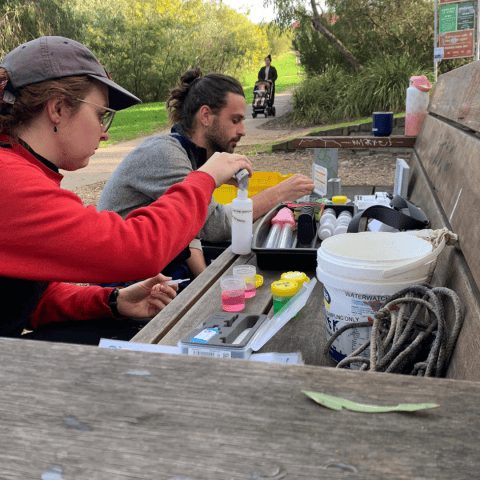 WaterWatch volunteers the Merri Mayflies
Make your festive season more meaningful by choosing gifts that have impact. The Friends of Merri Creek offer four delightful gifts that bring stories of Wurundjeri country into homes, with much of the proceeds* funding the protection of Melbourne’s much-loved waterway.
Select pickup when purchasing through the Friends of Merri Creek website, for collection from Thornbury (exact address shared after purchase). All of these products can also be purchased at the CERES Nursery and Bookstore.
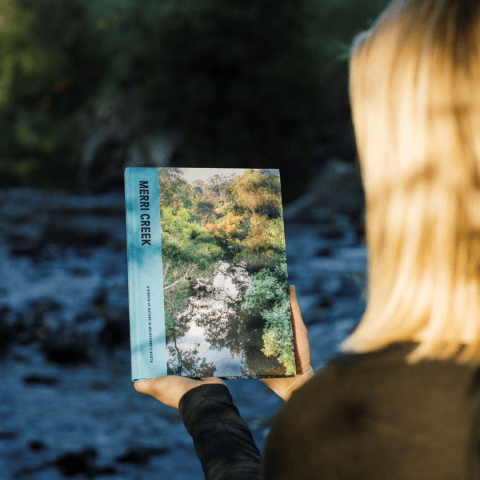 Photographs with thanks to designbynature.
Fiona Taylor is a Humanities and Geography teacher at Coburg High School, a local resident and a member of the Merri Birdies, one of the WaterWatch groups along the Merri Creek.
What’s your favourite spot on the Merri Creek?
There are too many to choose! One I love is where we do the Merri Birdies and WaterWatch monitoring with our Coburg High students, opposite De Chene Reserve. It’s quite enclosed under the trees, and the sound of water flowing over the rocks is so peaceful. I also love riding along the track, especially in drizzly rain. I always arrive in the best mood after riding along the creek.
Favourite time of year?
I love spring – the cygnets and ducklings and the wattle and eucalypts flowering, seeing deep into the creek, inspecting the fish and creek bed.
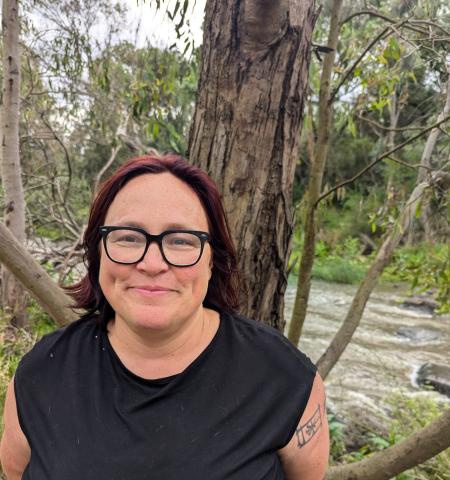 Fiona Taylor, member of WaterWatch group the Merri Birdies and teacher at Coburg High School.
As Merri Creek Management Committee completes its 35th year of protecting and restoring the Merri Creek, we enter a new organisational chapter, with the departure of former Manager and hugely influential Merri Creek advocate and devotee, Luisa Macmillan. While Luisa completed her Manager role in August 2023, we have continued to benefit from her expertise and experience through a part-time role as Manager, Special Projects, which concluded in October.
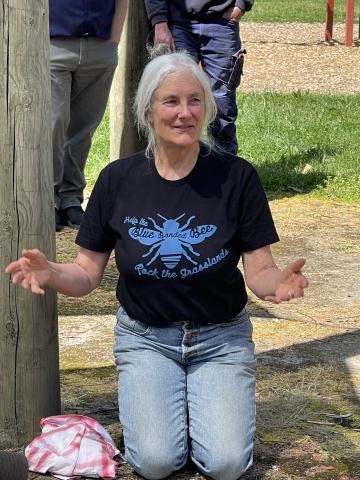 Luisa Macmillan, who led MCMC for over 21 years.
As Harry White spent the day walking along a long stretch of the Merri Creek lined with big, old red gums and listening to the trickle of water over rocks, he reflected on the joys of working on Wurundjeri Country.
“We were searching for weeds like Chilean Needle Grass, but as we walked, we spotted some Growling Grass Frogs – which hadn’t been seen in that part of the creek for several years – and a Sacred Kingfisher. It was really special.”
At the time, Harry was a Melbourne University student, fulfilling the work placement requirements of his Masters of Ecosystem Management and Conservation at Melbourne University, under the guidance of MCMC’s Ecological Restoration Program Coordinator Chris Geary.
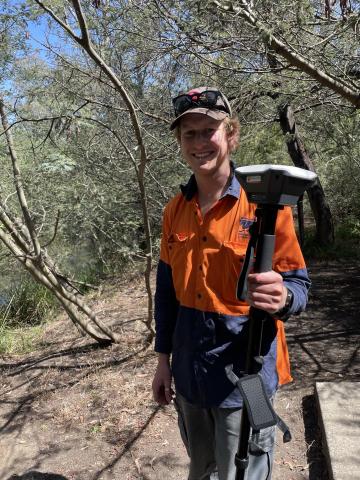 Harry White, MCMC Ecological Restoration Team and former Melbourne University student.
The Krefft's Glider, one of Australia’s most endearing nocturnal marsupials, is a master of the night. With large eyes and thick grey fur, these tiny mammals can glide distances of 50 metres or more, spreading their limbs to expose soft membranes – known as patagia – and traversing from tree to tree under the cover of darkness.
Thanks to this remarkable soaring ability, Krefft's Glider (previously known as the Sugar Glider) rarely descend to the forest floor. Living in small social groups, they nest in tree hollows lined with fresh gum leaves – a characteristic marker of their presence.
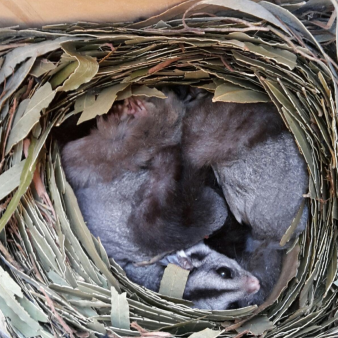 The distictive, clean nest of a Krefft's Glider (Petaurus notatus). Photo by Chris Cobern, MCMC.
In July, Landcare Victoria awarded Merri Creek Management Committee winners of the 2024 Australian Government Community Partnerships Landcare Award. This award acknowledged our work over 35 years, transforming the Merri Creek from a weed-smothered drain to a much-loved waterway running through a picturesque bushland corridor together with our many volunteer and Friends-of groups. We thank the many people that have been part of this ongoing journey and who continue to love the Merri Creek through their volunteering, their advocacy, their donations and their support.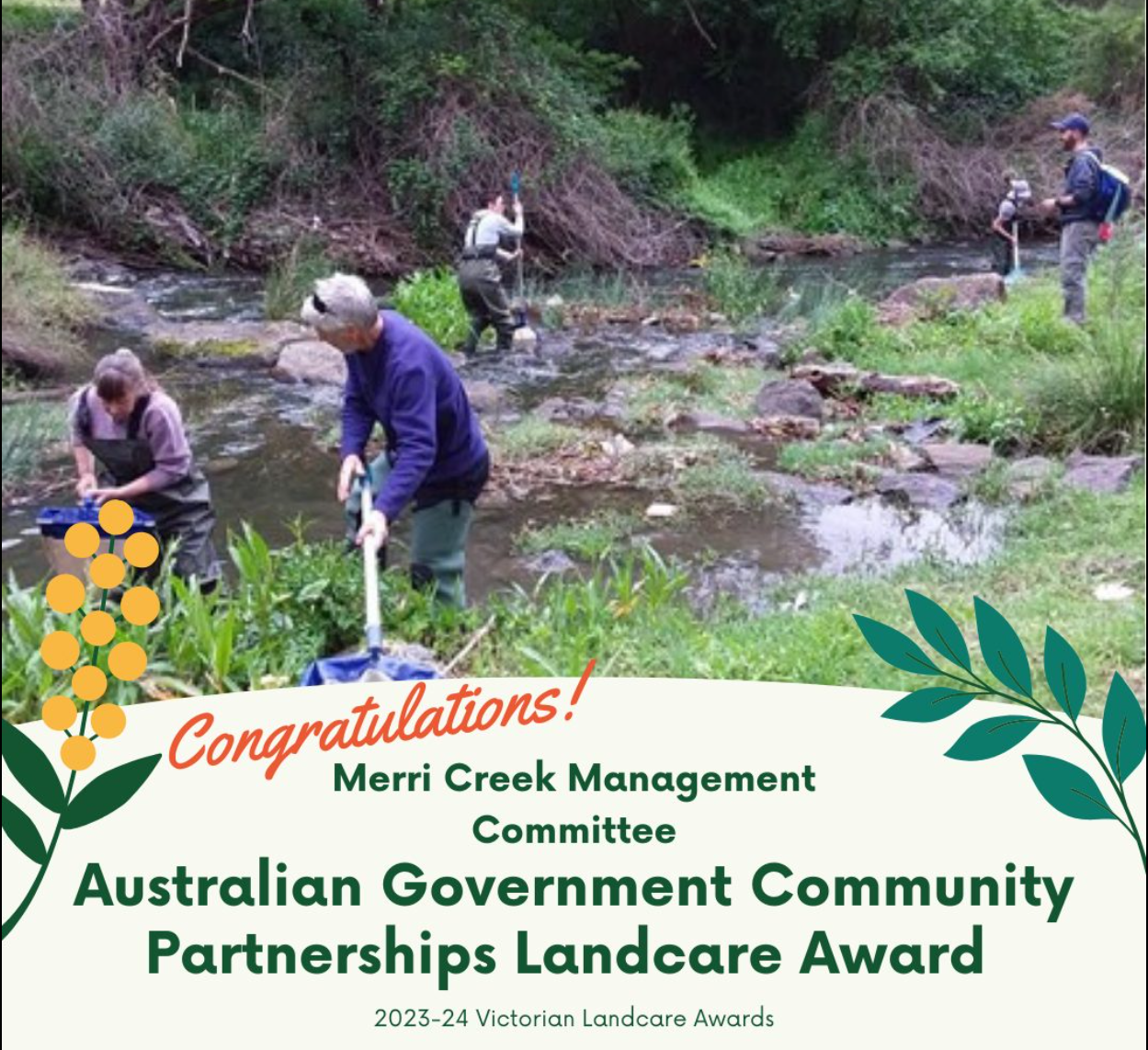
The awards received a record number of 146 nominations over 16 categories. We congratulate all nominees and award winners, including our friends at Darebin Creek Management Committee (DCMC) together with Narrap, the natural resource management unit of Wurundjeri Woi-Wurrung Cultural Heritage Aboriginal Corporation who we work with regularly. Narrap and DCMC won the First Nations Landcare Collaboration Award in recognition of their knowledge sharing and skills exchange with other community organisations.
Merri Creek Management Committee now goes into the National Landcare Awards, which will be announced in June 2025.
More Articles …
- Pencil and paper bring plants into focus at Bracken Creek
- Growling Grass Frog fans answer its call
- Melbourne Water rejoins Merri Creek Management Committee
- My Place: Claudia James, Wallan Environment Group
- Porneet on the Merri
- Design award win for marram baba Merri Creek Parklands signage
- Golden hour: a surprise visitor to Merri Creek
- The boy who loved frogs
- How one woman helped to grow a nature-loving community
- My place: Jane Miller
Page 6 of 16
Merri Events Calendar
09:30AM - 11:30AM
FoMC Coburg Lake & Surrounds - Wednesday Working Bee
09:50AM - 12:00PM
FoMC Wednesday Volunteers
09:30AM - 11:30AM
FoMC Coburg Lake & Surrounds - Friday Working Bee
09:30AM - 11:30AM
FoMC Coburg Lake & Surrounds - Wednesday Working Bee
09:30AM - 11:30AM
FoMC Coburg Lake & Surrounds - Friday Working Bee
10:00AM - 12:00PM
FoMC Litter Cleanup - Brunswick East
02:00PM - 03:30PM
FoMC: StreamTeam Water Quality Testing
09:30AM - 11:30AM
FoMC Coburg Lake & Surrounds - Wednesday Working Bee
09:30AM - 11:30AM
FoMC Coburg Lake & Surrounds - Friday Working Bee
10:00AM - 12:00PM
FoMC @ Merri Park - Woody Weed Whacking



Connect on Social Media |


 Merri Creek Management Committee. 2 Lee St, East Brunswick, Victoria, Australia 3057 (view map in new window )
Phone:(03) 9380 8199 Email: ABN: 13 025 599 242
© Merri Creek Management Committee