
As a child, Doug Frood was, in his own words, “that weird kid” – the one who loved insects, rocks and birds, and spent as much time as possible walking and camping in nature.
“Plants were my specialty,” he says. “Partly because I’m short-sighted and they don’t fly away like birds do. But also, I’ve just always had an affinity for them.”
That early passion for plants grew into a career as a botanical field ecologist. In the late 1980s and early 90s, Doug was working for the Victorian Government when he first spent time surveying grasslands along the Merri Creek.
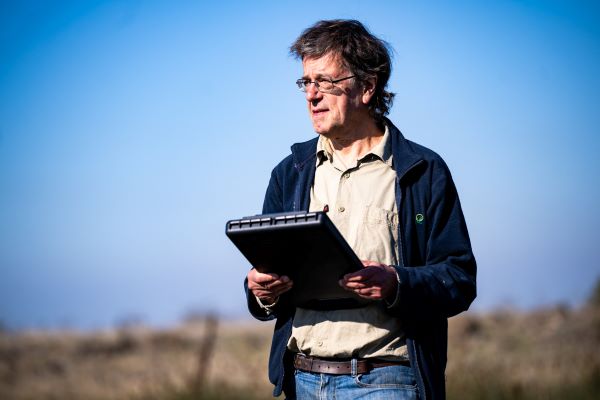 Doug Frood at Curly Sedge Creek. Photograph by Annette Ruzicka Photography.
“I got Atticus when he was four months old, and he’s an absolute pocket rocket. He’s like 10 border collies in one,” laughs ecologist and conservation dog handler Annett Finger. “He has so much drive that I have to do some kind of work or training with him on every walk we take. If I don’t, he pesters me!”
That intense energy is now being channelled into an unlikely conservation partnership. Together, Annett and Atticus are working with Merri Creek Management Committee (MCMC) to try and detect one of Victoria’s most elusive native plants – the critically endangered Matted Flax-Lily (Dianella amoena) – at Curly Sedge Creek and the surrounding galgi ngarrk grasslands.
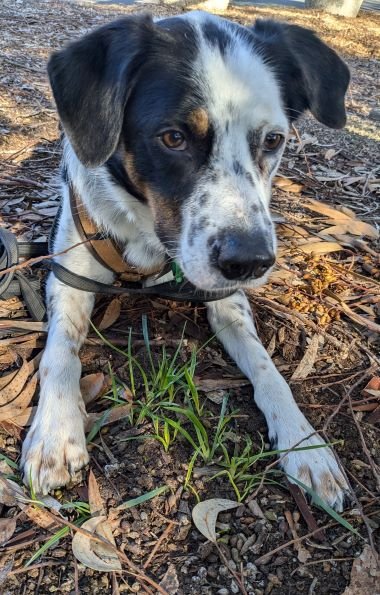 Atticus identifying Dianella. Photograph by Annett Finger.
Tucked behind the industrial fringes of Craigieburn, hidden from view by housing developments and highways, lies a unique patch of remnant grassland. And at its heart: Curly Sedge Creek.
Meandering through galgi ngarrk (formerly Craigieburn Grassland Conservation Reserve), this little-known tributary of Merri Creek still supports a remarkable array of life, including Growling Grass Frogs, Golden Sun Moths, and Latham’s Snipe.
Most significantly, it is Melbourne’s only stronghold for the nationally endangered Curly Sedge, described by MCMC’s Environmental Planning Lead Yasmin Kelsall as one of our most important local plants.
In February, a group of Merri Creek supporters came together at galada tamboore to celebrate the beginning of work on the marram baba Future Directions Plan and the funding of new initiatives and projects that are part of implementing the plan. The plan is the culmination of many years of work by MCMC and the members of the Parklands Partnership, towards a vision for continuous public parklands along Merri Creek.
MCMC President Ann McGregor says the contribution of many organisations has resulted in a plan that can make a real difference to creatures that call the Merri home, like the Little Eagle and Golden Sun Moth, as well as the future residents of new suburbs who will be able to connect with nature in the Parklands.
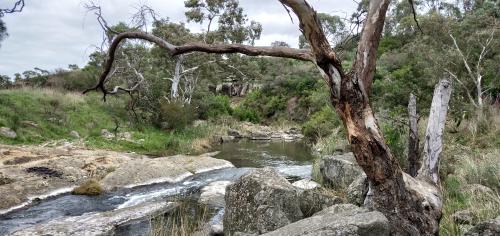 marram baba Merri Creek Regional Parklands. Photograph by Dom McKenzie.
If you moved through the Merri landscape in March, you may have noticed as the browns and yellows of biderap (dry, hot season for Wurundjeri Woi-wurrung people) gave way to the flowering of Manna Gum as iuk, the season where the length of days and nights shift until they are of equal length.
But below the surface of the Merri waters another story was unfolding, as it has for millenia: while waterbirds waded and insects darted above the water, in the depths of the Merri, Short-finned eels were maturing after an incredible journey that began as larvae in the salt waters of the Coral Sea, off the coast of Far North Queensland. These eels spend ten years or more in the fresh water of the Merri before metamorphosing into Silver eels. These eels inform the Wurundjeri name for this season: iuk means “eel”.
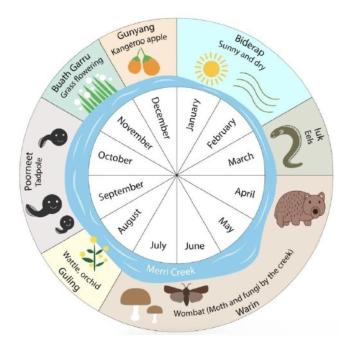
As we enter warin season, MCMC begins our Autumn burns season. We share our story of the growth of our burning program originally published in our recent 2022–2024 Biennial Report. Read the full report here.
In the remnant plains grasslands of the Merri Creek valley, the delicate, star-shaped flowers of the Matted Flax-Lily add a vibrant splash of violet to the landscape. The grasslands are slowly healing, responding to an ecological burn program spanning 30 years. In 2023, this included clearing of invasive weeds and grassy biomass, creating the conditions for native wildflowers to flourish.
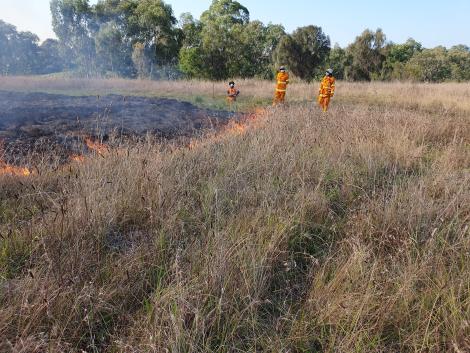 Autumn burn at Bababi djinanang, Fawkner. Photograph by MCMC's Michael Longmore.
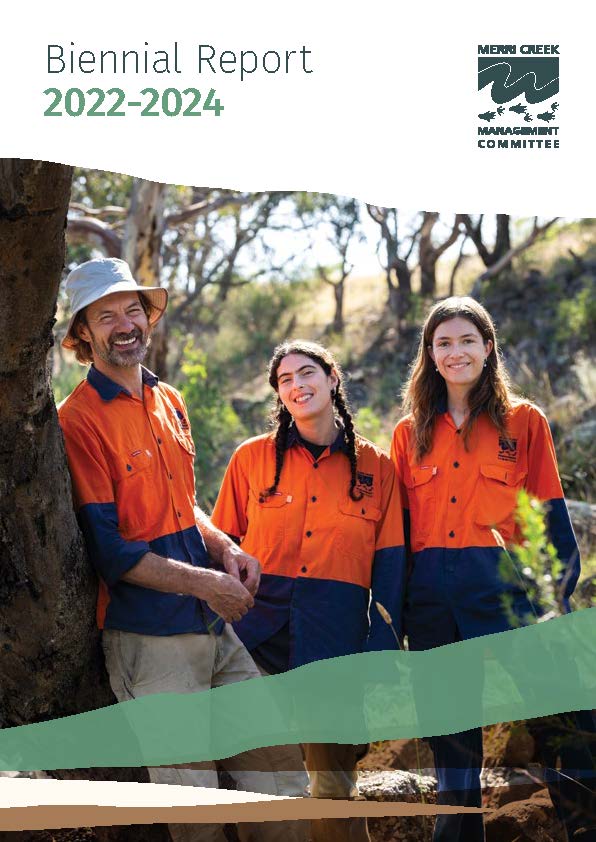
In February we were delighted to publish our 2022–2024 Biennial Report – a wonderful opportunity to share just some of the stories that we at MCMC are privileged to be a part of, with you, the people who make it all possible.
Paul Piko lives in Hidden Valley, a residential village and bushland area in the Upper Merri catchment on the northern edge of Melbourne. Paul is an orchid expert and Chairman of the Hidden Valley Environment Subcommittee, which formed in 2023 to support the work of the Wallan Environment Group and to protect the bushland in Hidden Valley.
Favourite spot in the Merri Creek catchment?
My favourite place in the Merri Creek catchment has to be the remnant bushland in the north section of the valley, which we unofficially call the Hidden Valley bushland reserve. The gullies feed into Mittagong Creek which in turn flows towards Merri Creek, not all that far from its source. When I moved into Hidden Valley I was delighted to discover this seemingly forgotten woodland. I was already an orchid enthusiast and was pleased to document a good number of species there, including one listed as Threatened. With the help of Chris Cobern from MCMC, we’ve also confirmed this bushland is also home to the Brush-tailed Phascogale. It is a special place.
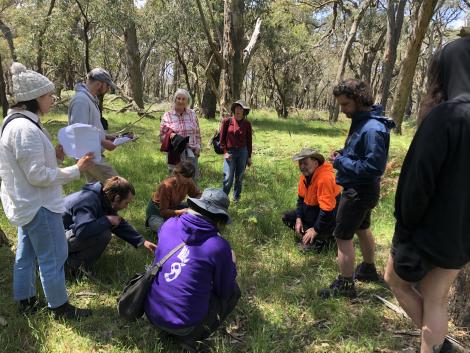 Paul Piko at the 2024 MCMC staff field trip. Photograph by MCMC's Chris Coburn.
A long-awaited feasibility study for the wallan wallan Regional Park has finally been released, sparking hope and enthusiasm among conservationists, local advocates, and the wider community.
This proposed parkland, extending north from the existing marram baba Upper Merri Creek Parklands, would protect a significant green corridor – comprising both environmental refuges and outdoor recreation areas – within Melbourne’s rapidly expanding northern growth corridor.
As Yasmin Kelsall, Environmental Planning Lead with Merri Creek Management Committee (MCMC), explains, the area consists of “a group of volcanic cones rising from a grassy plain full of wetlands with the Merri Creek running along one side. That combination of wetlands and volcanic cones – Green Hill, Spring Hill and Mt Fraser – is unique.”
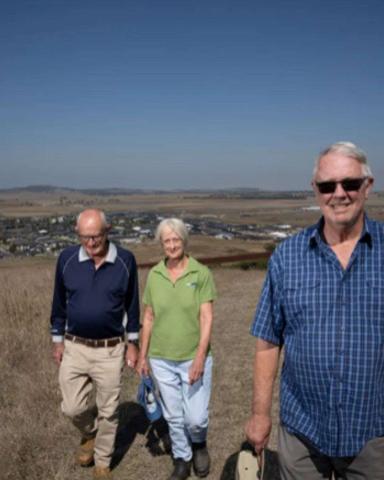 Wallan Environment Group members: Norbert Ryan, Cr Claudia James and Rod Eldridge.
On a beautiful sunny day in February during the biderap season, a group of land managers, scientists and community supporters gathered by wetlands in Fawkner’s Moomba Park to celebrate the launch of a new strategy for the Growling Grass Frog, a species that once thrived along the Merri Creek but now faces serious threats.
The strategy envisions a future where the frog is regularly heard and seen throughout the Merri Creek and its tributaries from Somerton to Fawkner, supported by collaboration between land and water managers, scientists, Traditional Owners, and local communities.
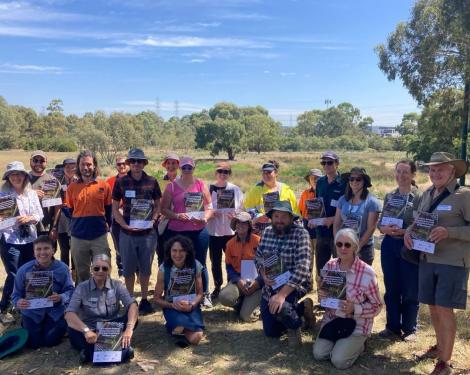 MCMC launch of the Strategy - 'Securing the Southern Metapopulations of the Growling Grass Frog in the Merri Creek.' Photograph by MCMC's Bernadette Thomas.
More Articles …
- Gunyang and Biderap
- Happy International Volunteers Week!
- Volunteers needed for our WaterWatch group near Growling Grass Frog habitat
- Merri Mayflies: citizen scientists of Merri Creek
- Gifts with impact
- My Place: Fiona Taylor
- Twenty years of restoration…farewell Luisa Macmillan
- Charting change: how vegetation mapping guides our restoration work
- Krefft's Gliders: the highflyers of the Upper Merri
- MCMC winner in the Victorian Landcare 2023/24 awards
Page 5 of 16
Merri Events Calendar
09:30AM - 11:30AM
FoMC Coburg Lake & Surrounds - Wednesday Working Bee
09:50AM - 12:00PM
FoMC Wednesday Volunteers
09:30AM - 11:30AM
FoMC Coburg Lake & Surrounds - Friday Working Bee
09:30AM - 11:30AM
FoMC Coburg Lake & Surrounds - Wednesday Working Bee
09:30AM - 11:30AM
FoMC Coburg Lake & Surrounds - Friday Working Bee
10:00AM - 12:00PM
FoMC Litter Cleanup - Brunswick East
02:00PM - 03:30PM
FoMC: StreamTeam Water Quality Testing
09:30AM - 11:30AM
FoMC Coburg Lake & Surrounds - Wednesday Working Bee
09:30AM - 11:30AM
FoMC Coburg Lake & Surrounds - Friday Working Bee
10:00AM - 12:00PM
FoMC @ Merri Park - Woody Weed Whacking



Connect on Social Media |


 Merri Creek Management Committee. 2 Lee St, East Brunswick, Victoria, Australia 3057 (view map in new window )
Phone:(03) 9380 8199 Email: ABN: 13 025 599 242
© Merri Creek Management Committee